
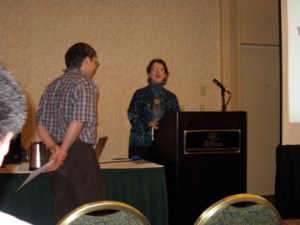
I’m sitting in with Ellen Frankel from JPS. This is going to be good.
Starting with a joke, three archeological teams – funny. Jewish people have always been at the forefront of innovation, especially with regards to communications tech.
Jews are caught in a dialectic, innovators devoted to ancient texts.
Focusing on the conversation over Hebrew Bible (TNK) and Talmud – dispersion is why the conversation is so important. Ellen is doing a brief history of Hebrews.
Disapora led Judaism to develop a culture that is surpirsingly like web 2.0 realities: social networking, standardized page formatting, linked content.
Jewish culture started as largely oral – oral cultures can’t survive exile. Northern tribes disappeared largely because they were an oral culture.
During the exile, Judaism transformed into a written culture: synagogue, core liturgy were key here. Text was open canon for years.
Rabbinic Judaism comes into power in the chaos after 70 CE. Rabbis canonized the Bible, and composed the Mishnah.
Ellen has a great road map to Jewish learning in a slide – oh I want to read this up close!
Jews began to say that written and oral traditions were equal. Written was God’s notes, the Oral was the actual lecture.
Rabbis invented the idea of proof-texting to get people to transfer old authority (priestly, prophetic, kingly) to them. Ellen calls it proto-hypertext.
The Mishna (repeat/review) was how the rabbis continued to speak to the written TNK.
Torah was the top, and the Misnah tried to deal with the needs of people – but the further from Jerusalem the less it worked (web 1.0).
Talmud was 2nd solution (web 2.0). Great show of a Talmud cheat sheet (again, I want the slide images).
Soogya (sp is totally off) – discussion of the rabbis looking at how to interpret the text in every way possible, running down every possible rabbit trail.
Talmud is about journey, not finding answers. The journey through the conversation was the point – even including many diverse opinions.
User generated content was added via question from jewish “rank and authority” and answers from Rabbis over centuries. This is called the Mikara’ot Gedolot (Great reading). JPS has this Bible for sale, I’ll be getting this.
Jewish Lexonaries always included commentaries.
Jewish intrepretation: PaRDeS
- Peshat: literal; plain sense
- Remez: allegorical; historical parallels
- Derash: homiletic; lessons for living
- Sod: mystical; coded language
Mikra’ot Gedolot had a clearly defined page structure.
Tagged Tankah coming whoopie!
Jewish textual innovation ground to a halt in 1400’s: secularization and threat of persecution were the causes.
19th Century brought secularization – holocaust nearly completed the secularization process, but it also spurred new creativity (like in ancient times). Nation of Israel is now leading people in communications technologies.
The Internet is the ultimate diaspora – no boundaries, no center. Many Jews involved in key Internet inventions (google, facebook, IM, etc.) Tagged Tanakh will continue Jewish innovation.
Check it out: www.JPSinteractive.org
Discover more from Painfully Hopeful
Subscribe to get the latest posts sent to your email.

One Comment
Comments are closed.