
I really dislike the phone. It’s annoying, intrusive, and demands my attention by an annoying clanging (or, worse, a digital rendition of clanging). For a while in the 1990’s I found a use for my phone-line, it got me on the Internet. When I got broadband, however, the phone just became annoying again. I don’t enjoy being interrupted for political ads, or Christian call-spam, or your pledge campaign. I don’t like that the person on the other end of the phone demands that I respond to their inquiry immediately. They do this because once the phone conversation is ended, it’s over, there’s no lingering connection.
I can count the number of friends I enjoy calling on the phone on one hand, and two of those I call only once or twice a year. I do use the phone, because people want me to call them on the phone, but I really don’t like it. I feel like I’m intruding.
I’m not alone, phones are on their way out. Not only landlines, but the concept of a phone is on the way out. Mobile devices are booming, but it’s becoming increasingly the case that phone-calls are among the least used features on these ever-present objects. Texting is used, the camera gets used, youtube gets watched, people even occasionally use e-mail or IM, but voice-calling isn’t a first-option. That list, by the way, is what I see teens and pre-teens doing on so-called “feature-phones” – on Smart-Phones it’s even longer.
Why bring this up? Well, earlier this week I got an e-mail from a friend who is planning on writing an article on how Church’s need to change the way they use phones. He had some good questions, and as we talked I kept on asking, “Do Churches really even need a phone?”
Here’s the thing, Churches seem to be continuing under the assumption that phones should the primary means of communication and everything else is secondary. The reality that has emerged, however, is actually the opposite. Texting, e-mail, Twitter, FaceBook, and instant messaging (among other things) have become the primary means of communication – I’m not even sure that the phone reaches secondary status.
What’s this mean for churches? Well, first it means that our voicemail message (in which we try to convey when the congregation worships, does discipleship, and that Jesus loves everyone who calls) is, almost entirely meaningless. Akin to this, it also means that paying to update your yellow-pages listing is also akin to mulching cash to put on your garden. If people want to connect to a Church, they aren’t calling it’s office number. Marketer’s, however, love to call the office number.
So how do people find out about a Church to see if they want to check the community out? Let’s take a look.
- They search for Churches in their area on google maps (or, bing maps if you must). Click here to see the Churches in my neighborhood.
-
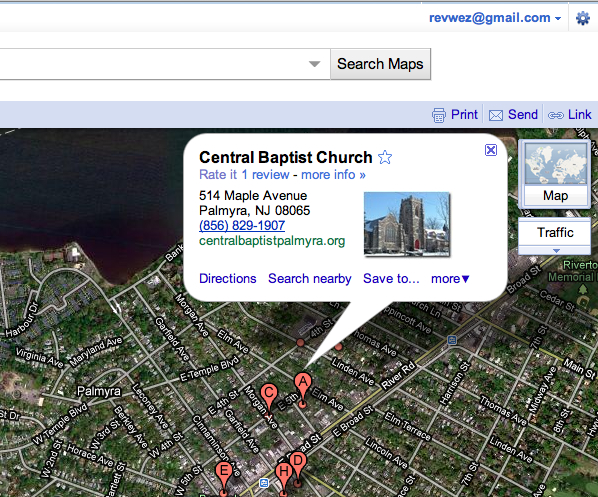
Central's listing on Google Places They see a Church with an interesting listing (if you notice, Central Baptist Church is first on the list – we have a complete Google Places profile so I believe it puts our ranking up higher). Once the see this listing, they click on it for more information.
- On the pop-up they see a link to Central’s web-site and follow it to find out more about the Church.
- Alternatively, they may click the “more info” link on Google pop-up and be taken to a Google place profile which has videos, images, and reviews of the congregation.
- If the person or persons doing the search want to ask questions, they may submit an e-mail inquiry to the church, or tweet their twitter account or leave a message on their Facebook fan page. Or, if they liked what they read, saw, heard on the site they might decide to stop by for a visit – using their GPS app or a Google Maps link for directions.
As you can see, people now have multiple ways to “cold-connect” with a congregation, and each one does a better job communicating than a rapid-speak voicemail message (which always get’s cut off – yet another annoyance born from the phone). Does this work? Yes. In the past 4 years we’ve had any number of visitors here, many of whom have stuck around and become part of our fellowship. Inevitably, I’m told that the fact that we had a decent web-site played a role in their coming out – and many have also said that the ability to connect on Facebook, twitter, e-mail, and IM have encouraged them to come back. Why? Because it shows that we have a voice and ears in their world – we’re able to speak into it, and able listen through it. We do this for the glory of Christ.
So, if you can, ditch your phone* – get broadband!
*Sadly, Central can’t currently take this step – our fire-alarm is dependent on a POTS line. We also have people who still believe that people look up phone numbers in the Yellow Pages (I won’t tell them we don’t have a listing there if you don’t).
Discover more from Painfully Hopeful
Subscribe to get the latest posts sent to your email.

Hm…yes and no. Yes, a good web presence is essential today. I have a Yellow Pages at my house; I don’t remember the last time it was opened. Whenever I want to find something, I do a Google search. Also, yes, I know people who seem to communicate primarily through text messages and similar things (my sister in law is one of them).
On the other hand, I still see phone calls as important, and I know I’m not alone. I feel like every level of abstraction in communication loses something. When you remove the face-to-face presence of the other person, you lose such things as facial expression, body language, etc. When you remove voice (i.e., moving past phone calls to pure text), you lose the communication inherent in tone of voice and so on. So, while it’s true that other modes of communication are becoming more popular, I still think a lot is getting lost.
I’m a geek. When I look at other geeks I know, I don’t think I’m quite deserving of the title, but other people consider me a geek, and I fit in better with real geeks than I do most other people. I have a smartphone, and I love it. I’m no stranger to text messaging (in fact, I can text on a standard telephone numpad without ever looking at the phone, faster than some people I know can type on a keyboard).
And, yet, telephone calls are still my primary method of communicating (unless I can talk to the person face-to-face). That seems to be even more the case with just about any real geek I know (when they communicate at all). And I’m sure there are a lot of older people out there who don’t even know how to do all the text messaging and such.
So, while I do kind of hate voicemail systems at churches that bother to tell me about all the times and such (that really should be on their website and church sign), I think that churches still need to keep a phone line available, since people *do* still use them. Churches should communicate in all available ways, but that still includes telephones.
Finally, I’m curious; what sort of demographics are you seeing being drawn to your church through all the other ways of communicating? Age, race, etc.?